Within the premises or local area environment the short haul modem is a
convenient device for configuring a reliable communications link. When
the distance between communicating data equipment gets beyond 100 feet
signals need 'to be boosted' or they will not be received and decoded
reliably. Using a pair of short haul modems in the link, one for
transmitting and one for receiving in each direction, boosts the signals
and gives the reliability.
However, a number of items always seem to come up when using a pair of
short haul modems to deal with this rather straightforward problem.
First, is the issue of speed and distance. The network architect always
wants to get the highest speed over the longest distance - and of course
in the most economical way.
Secondly, there is the issue of cabling. In many premises environments
cabling to form the data communications link connecting the modems is
not always readily available. Additional pairs of cable are 'tough to
get.' This presents a particular problem when full duplex transmission
is needed. Being able to realize it by dedicating a single pair of
cables to each particular direction may be 'out of the question.' The
network architect may have to look to achieve full duplex transmission
using just a single cable pair to implement the link.
Finally, there is the matter of isolation. The need for isolation arises
when ground currents are present. In many instances the data equipment
communicating must be grounded at different points. Different grounds
imply different reference levels for voltages. Ground currents are
generated in an attempt to achieve equilibrium between different ground
points. From the perspective of communications such currents make
themselves known as an additional interference mode. Isolation provides
a barrier between different ground points. This barrier does not allow
ground currents to be generated. Isolation allows equipment being
grounded at different points to be connected together without the need
to worry about the interference due to ground currents.
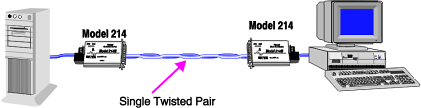
The Model 214A can handle all of these issues. Its employment in a
typical 'store' application is shown in the illustration above. Here we
have a PC communicating with a host computer. The two computers are
interchanging files of accounting data. The PC located at a point of
sale is sending the host rapid updates on 'sales being made.' The host
is sending back continuous updates on 'available inventory.' The only
way the two computers can keep up with each other is by having full
duplex transmission. However, note that the communication is
asynchronous, as it is being driven by individual sales that occur
randomly in time. Here speed and distance are definitely issues. For the
computers to keep up with the processing they have to be able to receive
the data as fast as possible over the distance, which is perhaps 1000
feet. However, cabling is a problem. There is only one spare cable
available to configure the link. The Model 214A works well in this
situation. It can provide a data transmission speed of up to 38.4 KBPS
at a distance of up to 3 miles, asynchronously and full duplex on just a
single cable pair.
Returning to the application in the illustration. The two computers as
well as the modems are most likely grounded at different points. Ground
currents may develop which can interfere with the communications. The
Model 214A though has transformer isolation, which can ameliorate this
deleterious effect.
|
